

A Comprehensive Guide on How to Syringe Ears at Home Safely
Updated: Jan 7
Understanding Ear Syringing at Home
I understand why people search for “how to syringe ears at home” — blocked hearing is frustrating and, in some cases, it can feel urgent. In the clinic, I see problems caused by well-intended DIY attempts far more often than most people realise.
In the UK, what many people call “ear syringing” is usually ear irrigation (controlled water flushing). The NHS notes that not all GP surgeries offer wax removal, but where it is offered, it may be done via electronic ear irrigation, microsuction, or manual removal.
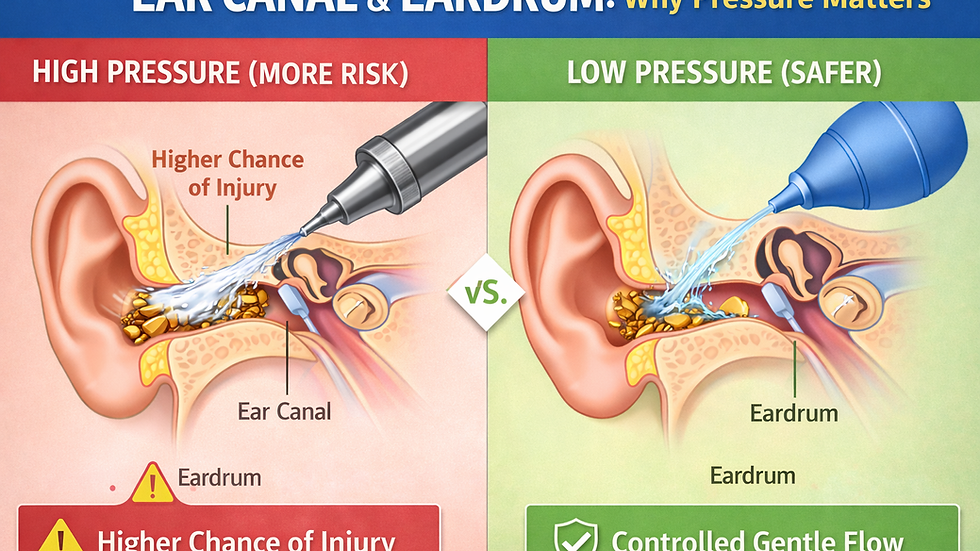
Traditional manual metal syringes are specifically discouraged in clinical service guidance because pressure is harder to control and the risk of injury is higher.
This article focuses on the safest, most conservative approach:
What you should try first.
Who should not irrigate at home.
How low-pressure bulb irrigation is typically done if you’ve been advised it’s appropriate.
What Does “Ear Syringing” at Home Mean?
At home, “syringing” typically falls into one of these categories:
Wax softening drops only (often enough for mild-to-moderate wax).
Bulb syringe irrigation (a gentle squeeze bulb, not a high-pressure syringe).
High-pressure devices / metal syringes / jet systems (I do not recommend these at home due to higher risk).
Step 1: Soften the Wax (NHS First-Line Self-Care)
If earwax is the cause, the NHS recommends softening it with 2–3 drops of olive or almond oil, staying on your side for 5–10 minutes, and repeating 3–4 times a day for 3–5 days. A pharmacist can also recommend drops designed to dissolve wax.
Do not use drops if you have (or suspect) a perforated eardrum.
Who Should NOT Syringe or Irrigate Ears at Home?
Please avoid home irrigation and seek clinical assessment if any of the below apply (these mirror common contraindications used in NHS service specifications):
Past or current eardrum perforation, suspected perforation, or ear discharge (recent or persistent).
Grommets (ear tubes) in place.
Previous ear surgery (unless a clinician has explicitly said irrigation is safe for you).
Ear infection now, recent middle ear infection, or significant ear canal inflammation (otitis externa).
Significant pain, severe dizziness/vertigo, or sudden hearing change.
You rely on hearing in only one ear (do not risk your only-hearing side with DIY irrigation).
Higher-risk situations (use extra caution and get advice): diabetes/immunocompromise, recurrent tinnitus/otitis externa, anticoagulants.
If you’re unsure, the safest move is an ear examination first.
How to Syringe Ears at Home Using a Bulb Syringe (Safety-First Method)
Important: NICE CKS notes there is limited evidence around safety for self-irrigation, so it is not broadly recommended as a standard “do-it-yourself” solution. That said, some NHS GP practices provide patient instructions for gentle bulb syringing after a period of wax softening.
If you’ve been advised it’s appropriate for you and you’re using a bulb syringe kit, these are the typical safety steps:
What You Need
A pharmacy bulb syringe (not a metal syringe).
Clean water warmed to body temperature (not hot).
A towel/bowl (or do it in the shower).
Step-by-Step (Gentle Technique)
Soften first: Use olive oil or sodium bicarbonate drops daily for at least several days (some pathways suggest longer for stubborn wax) before attempting the bulb.
Fill the bulb with clean warm (not hot) water.
Position: Tilt your head so the affected ear is upward; protect clothing with a towel.
Straighten the canal: Gently pull the outer ear up and back (adults) to help water reach the wax.
Irrigate gently: Place the nozzle only at the entrance (do not push it in) and squeeze gently—no force.
Let it drain: Tilt over a sink/bowl so water runs out; you can gently wiggle the outer ear to help drainage.
Repeat cautiously: A small number of gentle squeezes may be repeated. If it’s not working, do not escalate pressure.
Stop immediately if you feel pain, sharp discomfort, new ringing, significant dizziness, or sudden hearing worsening, and seek clinical advice.
Why “Gentle and Warm” Matters
Clinical guidance stresses:
Water around body temperature (too cold/hot can provoke dizziness/vertigo).
Stopping if pain or dizziness occurs.
Aftercare: What to Do Once You’ve Irrigated
Let the ear drain fully and dry the outer ear with a towel.
Avoid putting anything into the ear canal (cotton buds push wax deeper and irritate the canal).
Watch for symptoms of irritation or infection over the next 24–48 hours: increasing pain, itch, swelling, discharge, or worsening hearing — these require review.
When Home Syringing Hasn’t Worked
The NHS advises seeing a clinician if symptoms haven’t cleared after a short period of self-care, or if the ear is badly blocked and you cannot hear (infection risk can increase if severe blockage persists).
At Ear Wax Solution, we can examine your ears and remove wax using the most appropriate method. Many people prefer microsuction because it’s dry (no flushing water into the ear).
Relevant Service Links:
Microsuction ear wax removal: Microsuction Ear Wax Removal
Home visits (Surrey, London, Kent): Home Visits
FAQs
Is Ear Syringing at Home Safe?
It can be safe for some people if it’s gentle, low-pressure (bulb syringe), and you have no contraindications. However, NICE CKS highlights limited safety evidence for self-irrigation, so it should be approached conservatively.
What Should I Never Do at Home for Ear Wax?
Don’t insert cotton buds or objects into the ear canal (often makes blockage worse).
Avoid high-pressure syringes/metal syringes; clinical guidance warns against them due to injury risk.
Avoid ear candles (no proven benefit and potential injury).
How Do I Know If It’s Wax or an Infection?
You can’t confirm reliably without looking in the ear. If you have pain, discharge, fever, or the ear canal is very tender, arrange clinical assessment rather than irrigating.
If you’re unsure whether it’s safe to irrigate, or you’ve tried drops and still feel blocked, the fastest and safest next step is an ear examination and removal under direct vision.
Book microsuction: Microsuction Ear Wax Removal
Request a home visit: Home Visits
Conclusion
In summary, while ear syringing at home can be tempting, it is essential to approach it with caution. Always prioritise safety and seek professional advice when in doubt. Remember, your hearing health is paramount, and professional services are available to ensure your ears remain healthy and clear.
References
NICE Clinical Knowledge Summaries (CKS). Earwax – Management. National Institute for Health and Care Excellence; updated regularly. Available at: NICE CKS
NHS England. Earwax build-up. NHS UK. Available at: NHS UK
NHS England. Ear irrigation (ear syringing) – patient information and safety advice. Available via NHS Trust patient leaflets (multiple trusts, standardised guidance). Accessed: December 2025.
Royal College of General Practitioners (RCGP). Ear wax removal and ear care guidance for primary care. RCGP; clinical service guidance.
British Society of Audiology (BSA). Recommended procedure: Ear examination and wax removal. British Society of Audiology; 2021.
ENT UK. Clinical guidance on earwax removal. London: ENT UK; professional guidance.
Coppin R, Wicke D, Little P. Management of earwax in primary care. BMJ. 2011;343:d4030. doi:10.1136/bmj.d4030.
Sharp JF, Wilson JA, Ross L, Barr-Hamilton RM. Ear wax removal: a survey of current practice. BMJ. 1990;301(6763):1251–1253. doi:10.1136/bmj.301.6763.1251.
Hand C, Harvey I. The effectiveness of topical preparations for the treatment of earwax: a systematic review. British Journal of General Practice. 2004;54(508):862–867.
10. Roland PS, Smith TL, Schwartz SR, et al. Clinical practice guideline: Cerumen impaction. Otolaryngology–Head and Neck Surgery. 2008;139(3 Suppl 2):S1–S21. doi:10.1016/j.otohns.2008.06.026.
11. Prowse S, Mulla O. Complications of ear syringing: a review. Journal of Primary Health Care. Referenced in UK primary care safety guidance.
12. NHS Improvement / NHS England. Advice on low-value interventions: Ear syringing. NHS England policy documentation.


Comments